

If you are looking for a home that sits exactly on the seam between Washington’s most vibrant nightlife and its most powerful business district, you are looking at Rhode Island Avenue NW. specifically, the stretch running from the 1300 block over to Scott Circle is a unique micro-neighborhood. It functions as a “Grand Boulevard” transition zone.
To the north, you have the historic charm and bustle of Logan Circle. To the south, you have the K Street power corridor and the White House. Living here means accepting a high-energy atmosphere. This isn’t a sleepy cul-de-sac; it is a major artery with heavy traffic and architectural grandeur to match. The hook for most buyers here is simple: you can walk to a power lunch at The Hay-Adams and be back home in time to walk to dinner at Le Diplomate, all without ever hailing a ride.
With a Walk Score that consistently hovers between 96 and 98, this is arguably one of the most connected strips of pavement in the District. If you are thinking about moving to Washington DC and want to be in the center of the action, this avenue deserves a close look.
The Trade-Offs: Convenience vs. Commotion
Let’s be real about what it takes to live on a major DC thoroughfare. There is a distinct trade-off here between unbeatable convenience and urban commotion.
The biggest “pro” is the “15-minute city” lifestyle. For residents in this corridor, the daily commute often consists of a pleasant walk rather than a metro ride or a traffic jam. You have immediate access to the 14th Street Corridor’s bars and restaurants to the east, and the cultural institutions of Dupont Circle to the west. It is a central pivot point that puts the best of the city at your doorstep.
However, the “con” is the noise. Rhode Island Avenue is Route 29, a major commuter route. If you are sensitive to street noise, this is something to consider seriously. You will hear sirens, buses, and rush-hour traffic. While the side streets like Swann or Q Street offer a quiet, residential canopy, Rhode Island Avenue offers urban grit and energy. It feels more like downtown living than neighborhood living, which is exactly what some buyers love and others avoid.
Real Estate on the Corridor: Condos & Rowhomes
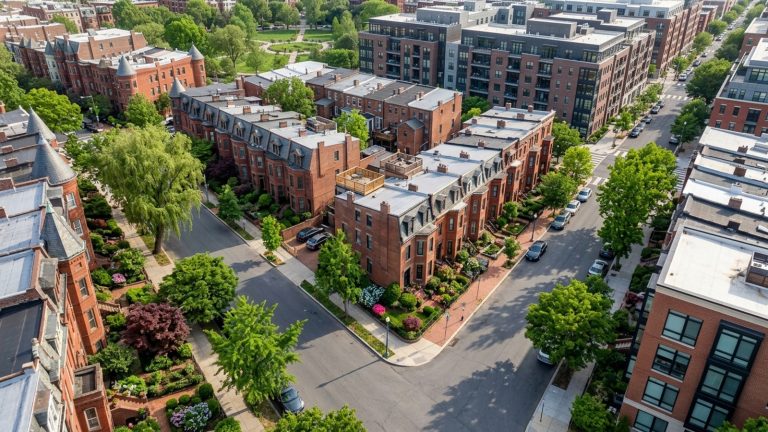
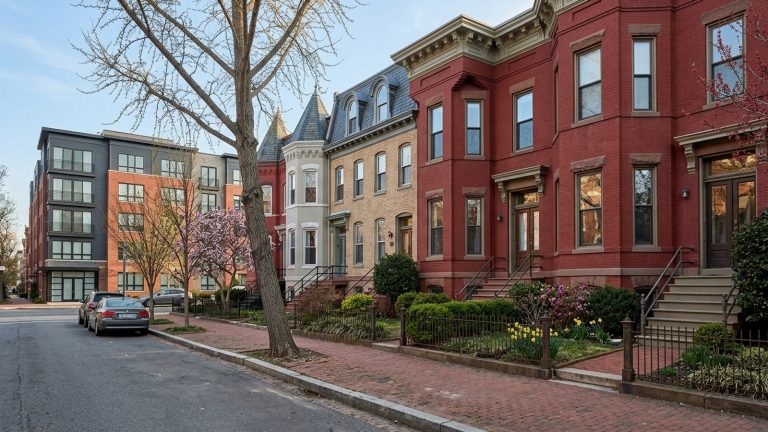
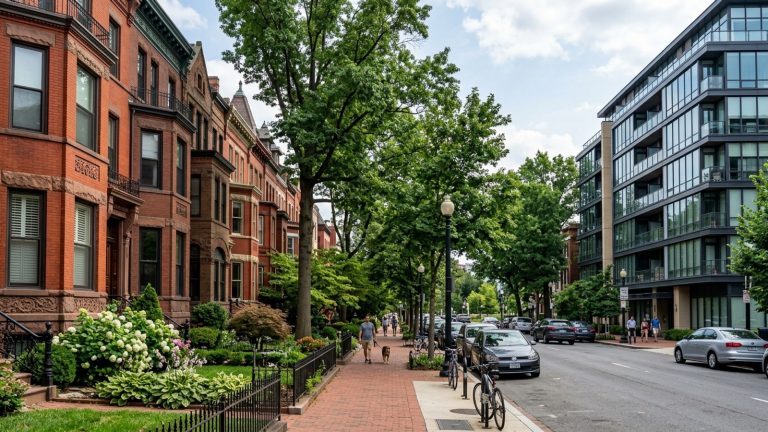
The housing stock along this avenue is a fascinating mix of the 19th and 21st centuries. When you walk the 1100 to 1300 blocks, you are greeted by “Grand Victorians.” These are massive, historic rowhomes—often 3 or 4 stories tall—that feature high ceilings and intricate brickwork.
Many of these grand structures have been converted into multi-unit luxury condos, while a few remain as expansive single-family residences. If you are looking at these converted rowhomes, you can generally expect prices for condos to range from $500,000 for smaller one-bedrooms to well over $1.2 million for multi-level penthouses. Intact single-family rowhomes in this specific area can easily exceed $3 million depending on the level of renovation.
Contrasting the historic stock are the luxury mid-rises that have filled in the gaps. This area is a great study in “Old vs. New.” For example, The Willison at 1425 Rhode Island Ave NW leans into the area’s history with a Colonial Revival aesthetic that fits right in with the older architecture. Just next door, Elysium Logan at 1427 Rhode Island Ave NW offers a starkly modern, glass-forward design for those who prefer contemporary lines.
If you prioritize amenities like a front desk and concierge, you might look at larger buildings like 1441 Rhode Island Ave NW. These full-service buildings offer a lifestyle that feels more like a hotel, which is a significant draw for busy professionals. Whether you want a boutique historic feel or a modern amenity-rich environment, checking a DC condo buying guide can help you navigate the specific condo fees and rules associated with these buildings.
Life on the Edge of 14th Street
Living on Rhode Island Ave NW means your daily routine is defined by proximity. You are technically on the southern edge of the Logan Circle neighborhood, which means you get the amenities without necessarily paying the premium for a view of the circle itself.
Grocery shopping is incredibly convenient. You have the Whole Foods Market on P Street just a few blocks north. It serves as the community pantry for the entire neighborhood. For quick needs, there are smaller markets and bodegas scattered along 14th Street.
Dining out is where this location truly shines. You are steps away from some of the city’s most famous tables, including Bresca and Le Diplomate. The advantage of living on Rhode Island Avenue rather than 14th Street itself is the buffer. You can walk to the nightlife in five minutes, but you don’t live directly above the late-night crowds.
For wellness, the area is packed with options. Vida Fitness on 15th Street is a massive complex that serves as a social hub as much as a gym. There are also numerous yoga and pilates studios tucked into the surrounding blocks, making it easy to maintain a fitness routine before or after work.
Commuting from Rhode Island Ave NW
For many residents here, the best commute is the one on foot. If you work in the K Street corridor, Downtown, Farragut Square, or McPherson Square, you are likely walking to work. This “walk-to-work” benefit is a primary driver for property values in this specific zip code.
If you do need to use the Metro, this location is a bit of a “tweener”—meaning it sits in the middle of several stations without being right on top of one. You are roughly equidistant to Dupont Circle (Red Line) to the west and McPherson Square (Blue/Orange/Silver Lines) to the south. You can also head east to the Shaw-Howard U station (Green/Yellow Lines). While none are right outside your door, having access to all lines within a 10 to 15-minute walk is a strategic advantage.
For bus riders, the 52 and 54 lines run heavily along 14th Street, connecting you north to Columbia Heights or south to the National Mall. The G2 bus is also a popular crosstown option for getting over to Georgetown.
Frequently Asked Questions
Is Rhode Island Ave NW noisy?
Yes, it is a busy commuter artery. You should expect street noise, sirens, and traffic, especially during rush hour. When viewing properties, pay close attention to the quality of the windows and whether the unit faces the street or the alley; rear-facing units are significantly quieter.
What is the difference between Logan Circle and Rhode Island Ave NW?
Logan Circle refers to the neighborhood surrounding the actual traffic circle and park, which tends to feel more residential and leafy. Rhode Island Ave NW acts as the southern border of that neighborhood, offering a grittier, more “downtown” city feel with taller buildings and heavier traffic.
Are there parking garages on Rhode Island Ave NW?
Street parking is extremely scarce and heavily restricted. Most residents rely on private parking spaces attached to their condo buildings. If your unit does not convey with a parking spot, you may need to rent a monthly space in a nearby commercial garage.
How far is the Metro from Rhode Island Ave and 14th St?
There is no Metro station at this exact intersection. Depending on your destination, you will walk about 10 to 15 minutes to reach either Dupont Circle, McPherson Square, or U Street/Shaw stations.