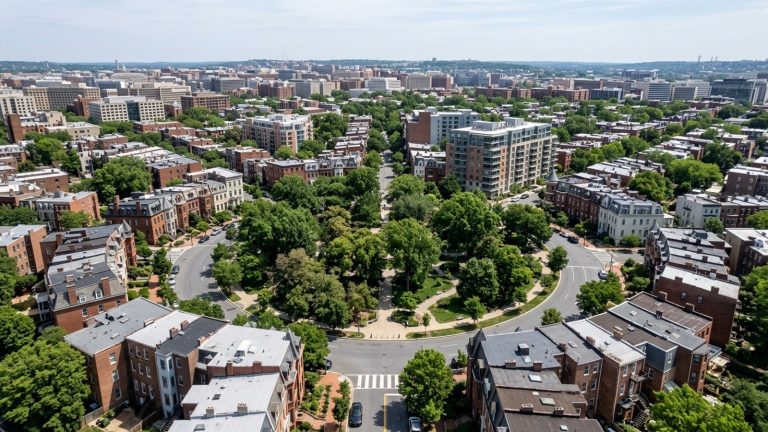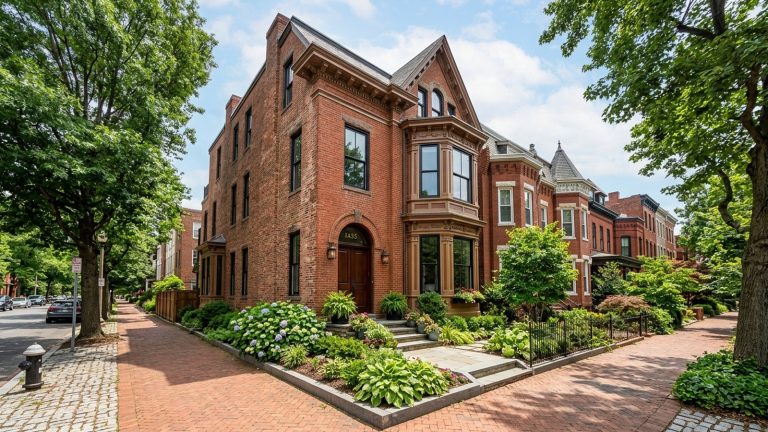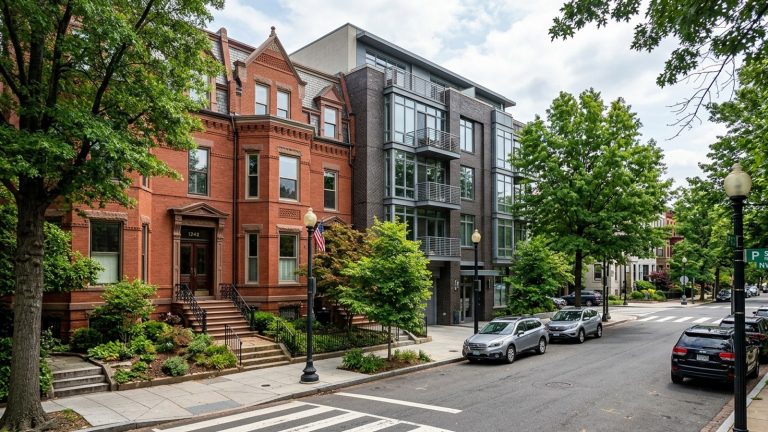

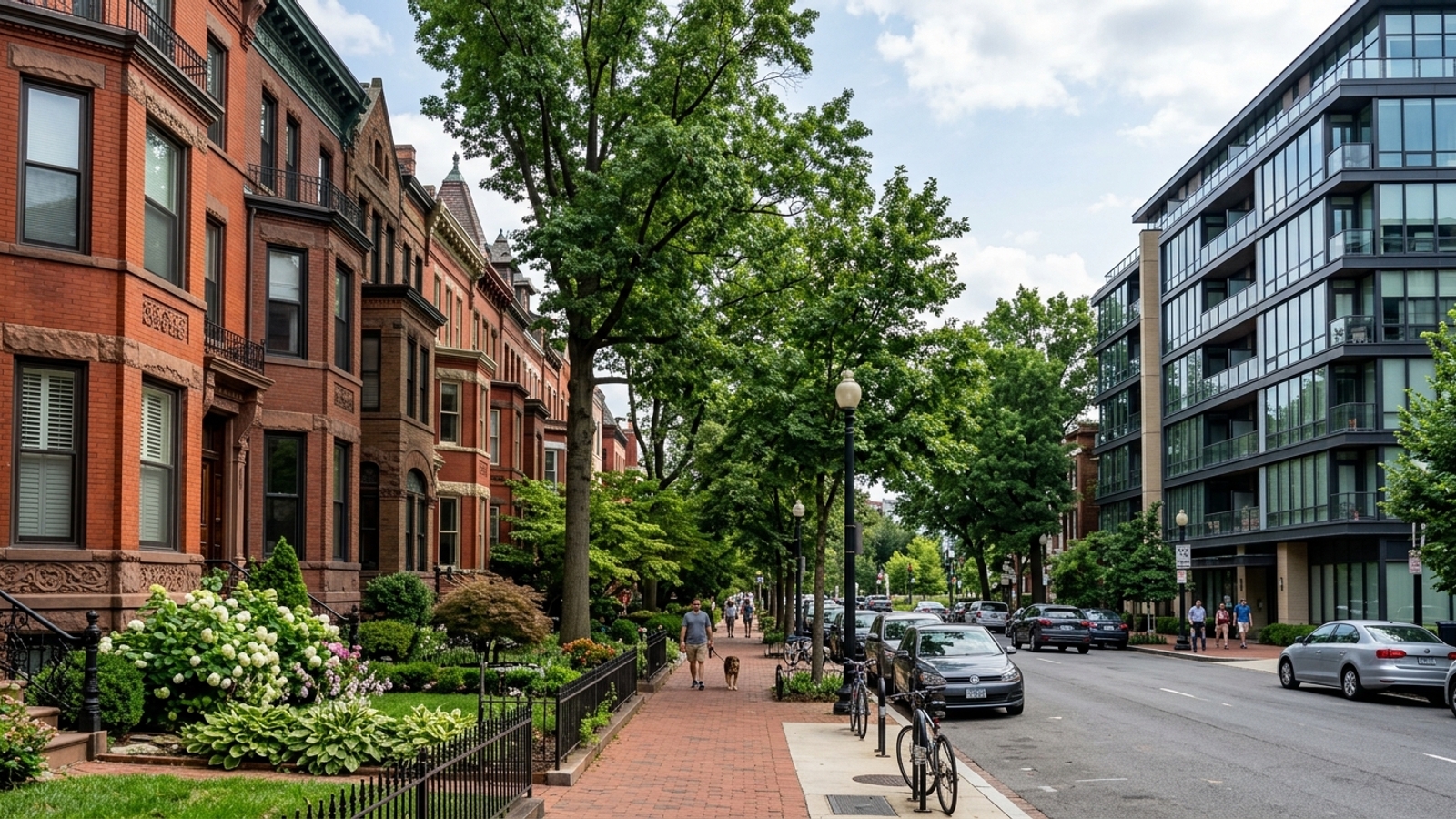
The median sale price in Logan Circle sits at approximately $814,717 as of mid-2026. The various types of homes in Logan Circle – historic rowhouses and modern condos alike – are spending around 53 days on the market before selling, which is a steady, deliberate pace that gives buyers some room to think.
That said, financing at this price point isn’t something you want to leave to chance. A quarter-point difference in your mortgage rate can move your monthly payment by hundreds of dollars. Knowing how local lenders price their loans, and what programs Washington, D.C. actually offers, puts you in a stronger position when it’s time to make an offer.
Where Mortgage Rates Stand for Logan Circle Buyers
As of August 10, 2026, the average 30-year fixed mortgage rate in the District of Columbia is 6.48% APR. The 15-year fixed rate averages 5.79% APR.
APR – the Annual Percentage Rate – includes both the interest rate and the lender’s fees. It’s the more honest number, because it reflects what borrowing actually costs you over the life of the loan rather than just the base rate on the tin.
Rates here track closely with the Federal Reserve’s policy decisions and move daily based on bond market activity and broader economic signals. What you see quoted this morning may not be what you see quoted this afternoon.
30-Year Fixed vs. 15-Year Fixed Options
The 30-year fixed remains the default choice for most buyers in the neighborhood. Stretching repayment over three decades keeps the monthly payment lower, which matters when you’re working with a purchase price in the $800,000 range.
The 15-year fixed – currently averaging 5.79% APR – gets you a lower rate in exchange for a higher monthly payment. The math on total interest paid over the life of the loan is meaningfully better, but you have to be comfortable with the compressed timeline.
Adjustable-Rate Mortgages
An ARM typically offers a lower introductory rate for a set period – five or seven years are common – before adjusting annually against an underlying financial index. For a buyer who’s confident they’ll sell or refinance before that initial period runs out, it can make sense. For everyone else, the uncertainty of where rates land after the adjustment is the risk you’re accepting.
What Influences Your Borrowing Costs
Two things lenders care about most: your credit score and how much you’re putting down. Borrowers above 740 with a 20% down payment generally see the lowest advertised rates. Below that threshold, the math starts shifting against you.
Put down less than 20% and lenders will typically require private mortgage insurance (PMI). That’s an added monthly cost that protects the lender if you default – not you – and it’s worth factoring into your total housing expense before you decide how much to put down.
Property type matters too. Financing a condo in Logan Circle can come with slightly higher rates or additional underwriting requirements compared to a single-family rowhouse, because lenders attach more risk to properties governed by condo associations.
Credit Scores and Debt-to-Income Ratios
Your credit history tells lenders how reliably you pay what you owe. A higher score means a lower rate – that relationship is direct and consistent. Your debt-to-income ratio, or DTI, compares your total monthly debt obligations against your gross monthly income. Most lenders want to see that below 43%, though some loan programs will stretch for well-qualified buyers.
Down Payments and Loan-to-Value
The loan-to-value ratio – LTV – measures your loan amount against the property’s appraised value. A larger down payment lowers the LTV, which signals less risk to the lender and often earns you a better rate. You don’t need 20% to buy a home; plenty of conventional programs allow as little as 3% down. Just run the numbers on what PMI adds to your monthly payment before you decide that’s the right move.
Property Types and Loan Purposes
A primary residence gets you the best rates. Lenders assume you’ll prioritize that payment when things get tight, which makes the loan less risky in their eyes. Investment properties and second homes carry higher rates and require larger down payments – the pricing reflects the additional risk lenders are taking on.
Home Loan Options in the District
For 2026, the Federal Housing Finance Agency set the baseline conforming loan limit at $832,750 nationwide. Because the Washington, D.C. metro qualifies as a high-cost area, the ceiling here reaches $1,249,125 for a one-unit property.
With Logan Circle’s median hovering around $814,717, most buyers can work within standard conforming loans. If you’re looking at one of the larger historic rowhouses that pushes past the $1.24 million mark, you’re into jumbo territory.
Jumbo loans don’t get sold to Fannie Mae or Freddie Mac – lenders keep them on their own books. That typically means stricter credit requirements and reserve expectations, and the rate pricing reflects whatever risk model that particular lender uses.
Conventional and Jumbo Loans
Conventional loans aren’t backed by any government agency, and they make up the bulk of what gets written in Logan Circle. No upfront funding fees, flexible terms, and straightforward underwriting for most buyers with solid profiles.
Jumbo loans serve the upper end of the market. If you need one, expect thorough documentation and higher reserve requirements. Lenders aren’t being difficult – they’re holding the loan themselves and they want to be confident in it.
FHA and VA Financing
FHA loans are insured by the Federal Housing Administration and allow credit scores as low as 580 with a 3.5% down payment. The tradeoff is mortgage insurance – an upfront premium plus an annual premium paid monthly.
VA loans offer zero-down-payment financing for eligible military service members and veterans, with no private mortgage insurance required. For buyers who qualify, it’s a genuinely strong option in this market.
District Homebuyer Assistance Programs
The District of Columbia’s Department of Housing and Community Development (DHCD) offers the Home Purchase Assistance Program (HPAP), which provides deferred-payment loans to help cover down payment and closing costs. DHCD also runs the Employer Assisted Housing Program (EAHP) and the Negotiated Employee Assistance Home Purchase Program (NEAHP), targeting District government employees and specific union members with additional financial support.
These programs have income and purchase price limits, so you’ll need to verify you qualify. Used strategically, they reduce the amount you need to borrow – which directly lowers your monthly payment.
DC Open Doors and Mortgage Credit Certificates
The DC Housing Finance Agency’s DC Open Doors program pairs down payment assistance with competitive mortgage rates. You can combine it with HPAP, which is worth knowing if you’re trying to maximize what you can pull together at the closing table.
A Mortgage Credit Certificate (MCC) lets first-time buyers claim a federal tax credit for a portion of the mortgage interest paid each year. That credit frees up income and can make it easier to qualify for a loan in the first place.
How to Compare Lenders Locally
Washington, D.C. property taxes run at $0.85 per $100 of assessed value for residential properties. Lenders fold that figure – along with homeowners insurance – into your estimated monthly payment, so the number you see on a Loan Estimate reflects more than just principal and interest.
Get quotes from multiple lenders on the same day. Rates move daily, so a quote from Monday compared to one from Thursday isn’t a real comparison. And if a lender offers discount points – an upfront fee to buy down your rate – do the math on how long it takes to recoup that cost through monthly savings before you agree to it.
Local Credit Unions Versus National Banks
National banks bring streamlined digital applications and a wide product menu. The volume they process can also mean rigid underwriting guidelines with less room for nuance.
Local credit unions and regional lenders know this market. They’re familiar with specific condo associations in Logan Circle and may offer portfolio loans or more flexible terms for borrowers whose situations don’t fit a standard template neatly.
Reading the Loan Estimate
Within three business days of applying, your lender is required to provide a standard three-page Loan Estimate. It breaks down the estimated interest rate, monthly payment, and total closing costs.
Pay close attention to Page 2. It separates the fees the lender controls from third-party costs like appraisals and title insurance – that’s where you can actually see which lender is giving you a better deal and which one is just quoting a competitive rate while making it up elsewhere.
Logan Circle Mortgage Rate FAQs
Are mortgage rates higher for historic rowhomes versus condos in Logan Circle?
No, the property type alone doesn’t typically push a rowhouse rate higher than a condo’s – it usually goes the other way. Lenders sometimes charge slightly higher rates or fees for condos because of the added risk that comes with condo association management. Historic rowhouses are treated as standard single-family homes for rate purposes.
Can I get a better mortgage rate from a local DC credit union or a national lender when buying in Logan Circle?
It depends on your financial profile and what each lender is promoting at that moment. National lenders often offer competitive baseline rates; local DC credit unions may have better terms for specific portfolio loans or localized assistance programs. Compare Loan Estimates from both on the same day – that’s the only way to know.
Do DC first-time homebuyer programs provide discounted mortgage rates for Logan Circle properties?
Yes. DC Open Doors offers competitive mortgage rates alongside down payment assistance, and you can pair it with the Home Purchase Assistance Program (HPAP) to reduce your total loan amount, which lowers your overall monthly payment.
Since many Logan Circle homes exceed standard loan limits, how do jumbo mortgage rates compare in DC?
Jumbo rates are often very competitive with – and sometimes lower than – conforming rates. With the 2026 high-cost conforming limit in the DC metro set at $1,249,125, you only need a jumbo loan if you’re borrowing above that amount. Lenders hold these loans on their own books and set rates based on their internal risk models.
How soon should I lock in my mortgage rate when making an offer on a fast-moving Logan Circle condo?
Lock as soon as your offer is accepted and you have a signed purchase agreement. Logan Circle homes are averaging 53 days on the market, so you have some runway in the process – but a locked rate protects you from market movement while you work through closing.
How do high HOA fees in Logan Circle buildings affect my debt-to-income ratio and the mortgage rate I qualify for?
HOA fees get counted in your debt-to-income (DTI) ratio calculation. Higher condo fees increase your total monthly obligations, which can push your DTI up and potentially affect the loan amount or interest rate you’re able to qualify for. It’s not a technicality – it’s a real number that lenders will use.