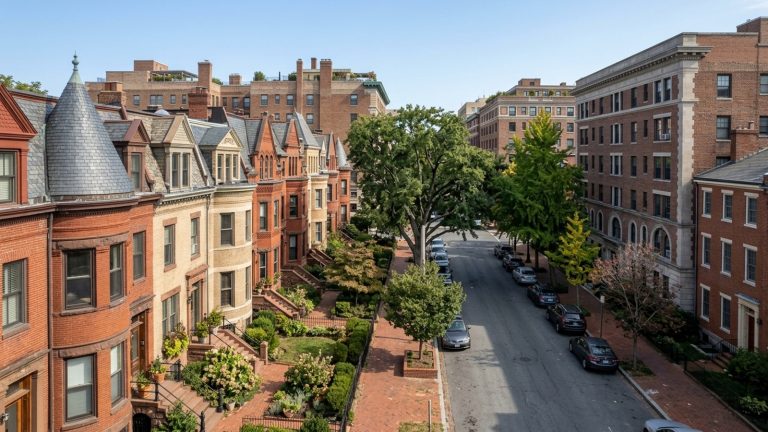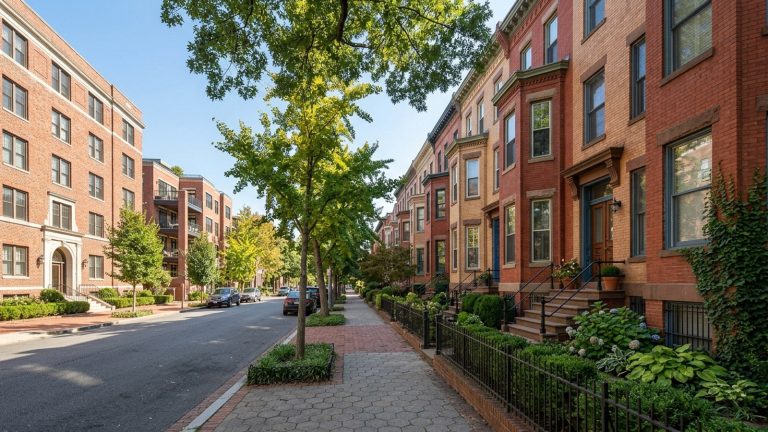

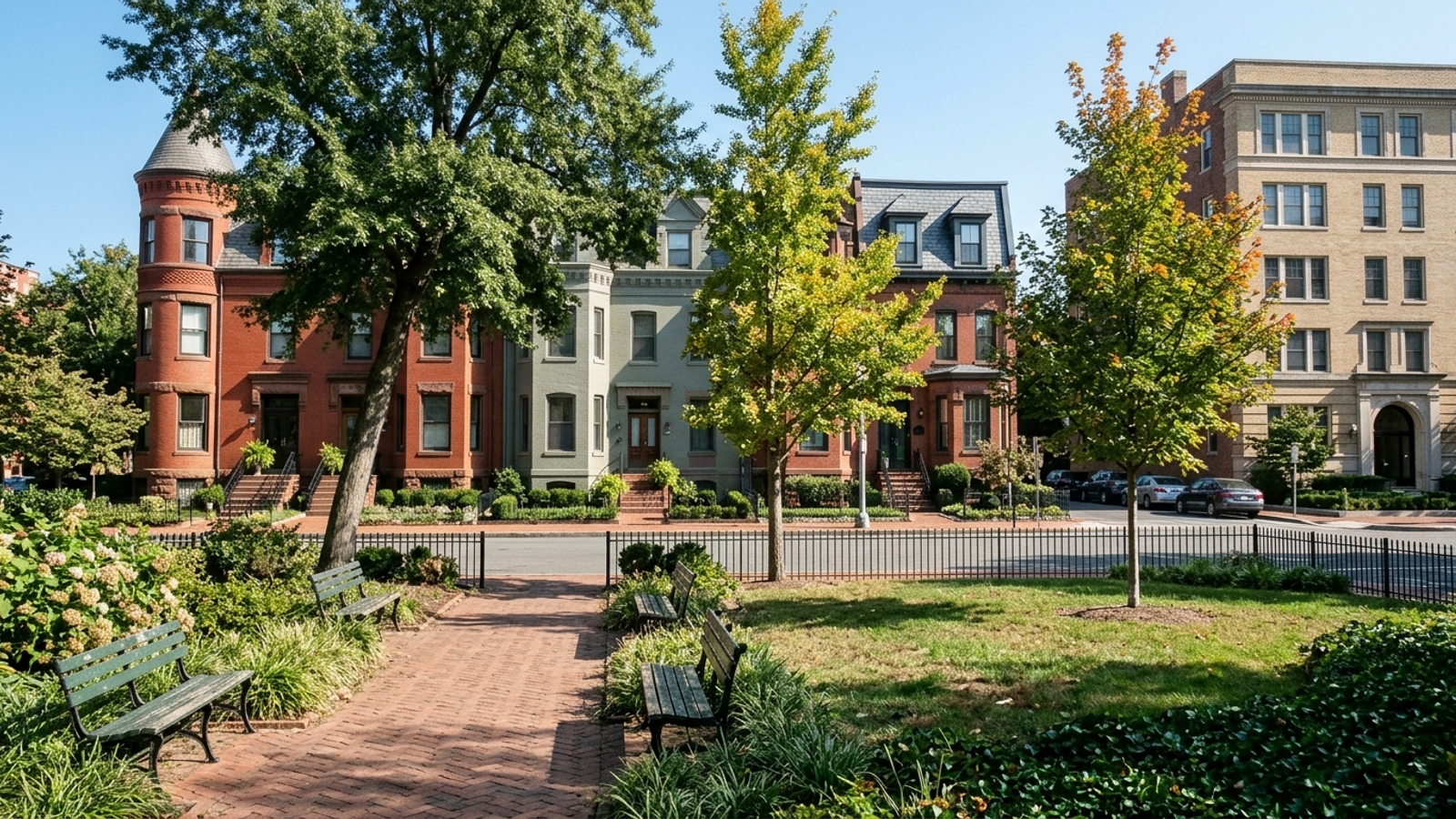
Dupont Circle condo prices rose sharply over the past year, but that headline number doesn’t mean a fast sale. Condos took a median 68 days to sell in the late summer and early fall of 2026, competing against nearly nine months of neighborhood supply. Higher prices and longer wait times are showing up together across the District.
Your selling timeline comes down to where your list price sits relative to those competing listings. Pricing off the recent appreciation figures is a quick route to the slow side of the median. Accurate pricing and patience matter more than optimism in this market, where 8.7 months of supply gives buyers time to compare options.
Key Takeaway
Plan on roughly three to four months from list date to closing in Dupont Circle. Homes spent a median 66 days on the market in the 90 days ending September 30, 2026, and the contract-to-closing period comes on top of that. Pricing close to recent sales and ordering condo documents before you list keeps you near that median. If your deadline is shorter, an as-is or cash sale trades some price for speed.
Who This Guide Is For
You own a home in Dupont Circle and are deciding when to list, how to price it, and whether a standard listing can meet the date you need to move or be paid.
How Long Does It Take to Sell a Home in Dupont Circle?
Condo prices in the neighborhood are up from a year ago, yet the typical condo still took more than two months to sell. Sellers face a market with 8.7 months of supply, where homes close near their list price overall. Your timeline is decided by how your unit compares to the 137 active listings around it, not by neighborhood appreciation trends.
The direct math: a little over two months on the market at the median, plus a contract-to-closing period that averages 36.8 days for a financed purchase. Work backward from your move date to pick a list date. If you have a firm deadline, build your plan on these median figures.
To map out your specific timeline, start by answering these four questions:
- Is your home a condo or a rowhouse? Condo owners can plan on the neighborhood pace and should start with Step 2 below to order the resale certificate and check FHA status. Rowhouse owners should read the section on condos versus rowhouses first, because the neighborhood median barely reflects their market.
- Do you need to be paid by a fixed date? Add the median time on the market to the contract-to-closing period in Step 4. If that runs past your deadline, go to the section on selling to a cash buyer.
- Did you buy the home less than two years ago? Read the section on selling within two years of buying before you pick a list date, since waiting a few months can change your tax picture.
- Has your listing already passed the neighborhood median without an offer? Go straight to the sections on when to revisit your price and the nearly nine months of supply.
What Days on Market Measures
Redfin defines median days on market as the number of days a home was listed before the seller accepted an offer and went under contract. This metric excludes homes that sat on the market for more than a year. It measures the time spent looking for a buyer, not the time spent closing the transaction.
Because this is a median, half of all sellers wait longer than 66 days to find a buyer. Build your plan on this figure rather than the fastest sale you heard about from a neighbor. It’s also a neighborhood-wide median, so your building or block can run well ahead of or behind it. Ask for recent comparable sales in your own building before you set a date.
Condos Versus Rowhouses
About five of every six Dupont Circle homes sold in the last 90 days were condos. Specifically, 40 of the 48 recent sales were condos, and they made up 101 of the 137 active listings. The neighborhood pace is essentially a condo pace.
The remaining non-condo properties showed just 8 sales against 36 listings. That’s too few sales to plan a timeline around. Rowhouse sellers should treat the neighborhood median as a weak guide and price off block-level comparable sales instead. There’s no reliable neighborhood pace figure for that type of home here, and the few sales that exist hint at more listings than buyers.
The Dupont Circle Selling Timeline, Step by Step
The total time to sell breaks down into four main steps: preparation before the clock starts, the active market period, and then the closing process. You can control the length of the first two steps by scheduling contractors early and ordering your building documents before buyers ask for them. The active market phase is the least predictable part, but accurate pricing helps shorten it.
Step 1: Prepare the Home and the Paperwork
Dupont Circle is a designated historic district, so exterior changes go through preservation review before work starts. The Historic Preservation Office clears the standard permit application for exterior work, which serves as the preservation approval. Interior-only preparation keeps your list date entirely in your control.
You’ll also need to gather the required DC seller disclosure forms and any lead paint records. If your home is tenant-occupied, DC tenant purchase rights can add time to your prep phase, since you must provide specific notices before selling.
An exterior fix that triggers preservation review can push your list date by weeks you didn’t plan for. Check with the Historic Preservation Office before you schedule contractors.
Step 2: Order the Condo Resale Certificate and Check FHA Status
In DC, a condo buyer can cancel within a set number of days after receiving the resale certificate. The law requires you to furnish this certificate on or before the 10th business day after the buyer signs the contract. Once they receive it, they have a three-business-day window to cancel the sale.
You should also look up your building on the FHA condominium approval list. FHA approval widens your buyer pool by allowing buyers with FHA loans to finance a purchase in your building.
Order the resale certificate before listing so it isn’t the bottleneck once you have a contract. The buyer’s cancellation clock starts only when the certificate arrives, so a slow management office can hold an accepted contract in limbo. Ask the association today how long theirs takes.
Step 3: From List Date to Accepted Offer
This is the longest and least predictable block, and your pricing strategy drives it. Only about one in seven Dupont Circle homes sold above asking in the last 90 days. Specifically, 14.9% of all homes sold above list price.
Buyers have plenty of inventory to choose from. Expect to negotiate rather than field bidding wars. Pricing to match recent comparable sales is the most reliable way to keep this step close to the median, and no one can promise a date for it. Every week on the market, your listing competes with new ones arriving, so a timeline that assumes a fast offer has no slack built in.
Step 4: From Contract to Closing
The average purchase loan closed in 36.8 days in March 2026. That typical timeline includes moving from application to rate lock in 11 days, then from rate lock to closing in an additional 26 days. Cash transactions can close much faster.
Condo deals add lender questionnaires and the resale-certificate window to this timeline. Appraisal and title work also take time, so add this period to your time on the market for a realistic paid-by date. An appraisal that comes in below the contract price can reopen negotiation and stretch this step. Being under contract is not the same as being paid.
Why Dupont Circle Homes Are Taking Longer to Sell
Sellers in this market face a direct trade-off between price and time. Two main forces are keeping the pace slow right now: the sheer volume of available homes gives buyers options, and a gap between rising prices and slow sales means buyers are pushing back on aggressive pricing. If you want a faster sale, you have to offer a price that stands out among the available inventory.
Nearly Nine Months of Supply
At the current sales pace, it would take almost nine months to sell every home now listed in Dupont Circle. The neighborhood currently sits at 8.7 months of supply for all homes.
The National Association of Realtors notes that historically, six months of supply is associated with moderate price appreciation and a balanced market. With supply well above that mark, buyers have time and options. Your list price is judged against the newest competing listing, and an overpriced home waits. Supply is also a neighborhood average: if several units in your building are listed at the same time, your effective competition is tougher than that figure suggests.
Rising Condo Prices, Slower Condo Sales
Dupont Circle condo prices are up 11.4% from a year ago, yet only 12.7% of condos sold above list price during the last 90 days.
A median price change partly reflects which units happened to sell over the last three months, so it doesn’t mean your specific unit is worth that much more. Price off comparable sales in your building, not off the headline appreciation number. Anchoring your list price to that appreciation figure is the fastest way onto the slow side of the median, in a market where barely one condo in eight drew an over-list offer.
How Long Is Too Long on the Market in Dupont Circle?
If your home sits past the 66-day median without an offer, the market is telling you that your price or condition doesn’t match buyer expectations. You’ll need a way to judge your stalled listing against the local data.
District Property Group can pull building-level comps and days-on-market history to help you see where your listing stands. From there, you can choose between adjusting the price and switching to a faster sale route.
When to Revisit Your Price
The typical Dupont Circle home sold for about 1.5% under its list price. The median sale-to-list ratio of 98.5% points to a typical result near $492,500 if you list at $500,000.
If offers land well below that mark, or showings dry up once you pass the median days on market, it’s time to reassess. Compare your pricing against your building’s recent sales to see if you missed the mark. A price cut can bring new buyers, but it also signals room to negotiate, and nothing guarantees it shortens the wait. Compare it against comps rather than cutting on a calendar.
Selling As-Is or to a Cash Buyer
This route trades price for speed and certainty. Selling for cash skips most preparation and financing steps, and it can shorten the contract-to-close period considerably.
If you’re comparing a cash offer with a standard listing, put both net amounts side by side. Include the HOA dues, taxes, and mortgage payments you’d carry while listed on the open market. Speed has a price, and knowing the difference between the two nets is the only way to make that call clearly.
What You’ll Net and When You’ll Be Paid
Your move depends on the exact date the funds clear and the final amount you take away from the closing table. Closing costs and tax timing both shape that final number, and District Property Group can map out a timeline and net estimate for a specific home.
Seller Costs at a DC Closing
In DC, the seller customarily pays the Deed Transfer Tax on residential property. The rate is 1.1% of the sale price for transfers under $400,000, and 1.45% on the entire amount for transfers of $400,000 or more.
Applying the 1.45% rate to the recent $449,900 condo median sale price results in a transfer tax of about $6,523. Real estate commissions are negotiable, and prorated property taxes and condo dues are settled at closing. Ask your title company for a seller net sheet showing transfer tax, prorations, and your loan payoff.
Your mortgage payoff and these costs come out at settlement, so the cash arrives only at closing, not when you accept an offer. Budget your move on the closing date, not the contract date.
Selling Within Two Years of Buying
Federal rules generally require two years of ownership and use within the last five to exclude a home-sale gain. Under these rules, a seller who meets the tests may exclude up to $250,000 of gain on the sale of a main home, or $500,000 if married filing jointly.
Sellers who don’t fully meet the tests may still qualify for a reduced exclusion, and a seller close to the two-year mark may gain financially by timing the list date around it. Listing a few months early can create a tax bill bigger than the cost of waiting. Confirm your dates with a tax professional before you set a list date. This is general information, not tax advice.
At a Glance
- Median sale price, all homes: $525,853 (90 days ending Sept. 30, 2026), up 1.1% year over year
- Median sale price, condos: $449,900 (90 days ending Sept. 30, 2026), up 11.4% year over year
- Median days on market: 66 for all homes, 68 for condos (90 days ending Sept. 30, 2026)
- Sale-to-list price: 98.5% for all homes, 98% for condos (90 days ending Sept. 30, 2026)
- Share sold above list price: 14.9% of all homes, 12.7% of condos (90 days ending Sept. 30, 2026)
- Months of supply: 8.7 for all homes, 7.8 for condos (90 days ending Sept. 30, 2026)
- Active inventory: 137 homes, of which 101 were condos (90 days ending Sept. 30, 2026)
- Homes sold: 48 in total, of which 40 were condos (90 days ending Sept. 30, 2026)
- Median price per square foot: $682 for all homes, $614 for condos (90 days ending Sept. 30, 2026)
Selling a Home in Dupont Circle FAQs
Are Home Prices Dropping in Dupont Circle?
No, they are currently rising based on the latest data. The all-homes median sale price rose year over year for the 90 days ending September 30, 2026. Condo prices rose even faster over the same period, though sales remain slow.
What Is the Slowest Month to Sell a Home in Dupont Circle?
August is typically one of the slowest months to sell. Metro-wide figures from Bright MLS show strong seasonality across the DC area, with median days on market slowing to 19 days in August 2026 compared to just 8 days in the fast April spring market. A slower month lengthens the active market step of your selling timeline.
How Much Do Dupont Circle Homes Sell for per Square Foot?
Homes sold for a median of $682 per square foot, and condos for a median of $614, during the 90 days ending September 30, 2026. Price per square foot is a useful rough check against comparable sales, but it’s not a complete valuation of your home.
Can I Sell My Dupont Circle Condo While a Tenant Lives There?
Yes, but DC tenant purchase rights may apply and add time to your sale. Under the Tenant Opportunity to Purchase Act (TOPA), owners of single-family accommodations must give the tenant a written notice within three days of receiving or soliciting an offer. Confirm your exact obligations with the Office of the Tenant Advocate before listing, as this is not legal advice.
What Disclosures Do I Have to Give When Selling a Home in Dupont Circle?
You must provide the standard DC seller disclosure statement to the buyer. The EPA also requires sellers of most housing built before 1978 to provide records of known lead-based paint, a lead hazard pamphlet, and signed acknowledgments in the contract. Confirm your building’s construction year to see if the lead paint rule applies.
How Long Does It Take to Sell an Inherited Home in Dupont Circle?
It depends on the probate process, which must grant the personal representative authority to sell before the market timeline begins. A personal representative appointed by the DC Superior Court Probate Division has broad statutory authority to sell real property immediately upon appointment, though creditors have a six-month period to file claims. Confirm with your probate attorney when the home can be listed and closed.
How Soon After Refinancing Can I Sell My Dupont Circle Home?
It depends entirely on your loan documents. There’s generally no mandatory waiting period to sell after a refinance, but check your mortgage note for any prepayment penalty. Your new payoff amount also reduces the net cash you take away at closing.
Can I Buy My Next Home Before My Dupont Circle Home Sells?
Yes, depending on your income, equity, and lender requirements. Options like a home-sale contingency or bridge financing allow you to purchase before selling, but a buyer-side contingency is less attractive to sellers. Because a Dupont Circle sale takes over two months at the median, a long wait on the market directly affects your next purchase.
Sources
- Redfin: Data Center
- ICE Mortgage Technology: May 2026 Mortgage Monitor
- BiggerPockets: Redefining What a Balanced Market Is
- DC Planning: Building Permits for Historic Property
- DC Code: Section 42-1904.11
- DC OTR: Recorder of Deeds FAQs
- IRS: Publication 523
- Bright MLS: April 2026 Housing Market Report
- DC Code: TOPA Single-Family Home Exemption Amendment Act
- eCFR: Lead-Based Paint Disclosure Rule
- DC Code: Section 20-741