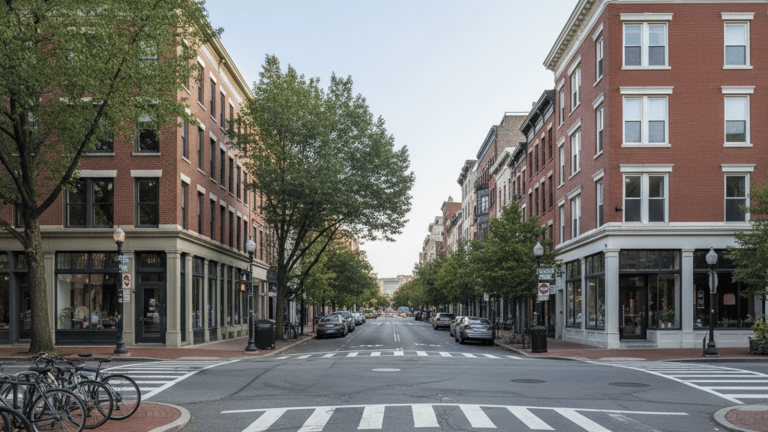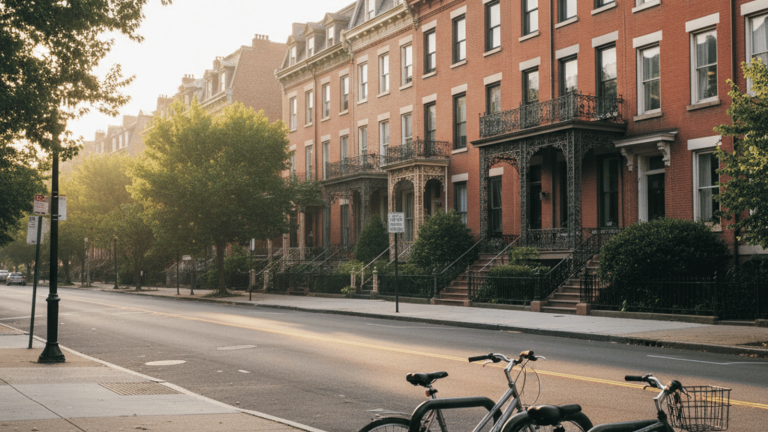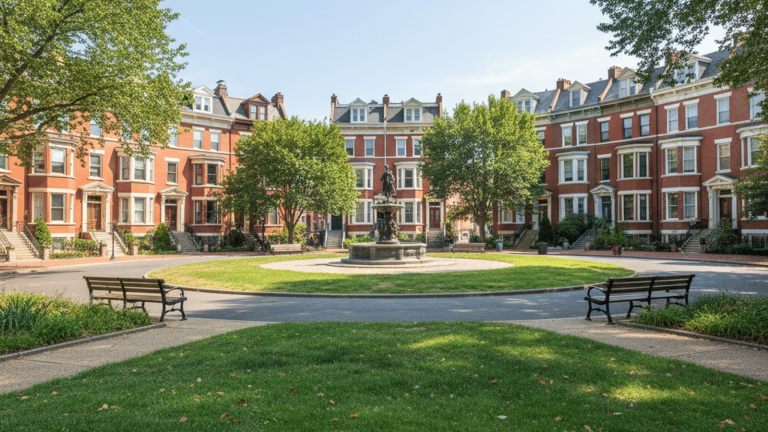

If you stand in the center of the park today, surrounded by perfectly manicured lawns and residents walking their dogs, it’s hard to imagine that this upscale enclave was once a muddy refugee camp. Logan Circle in 2026 feels like a living museum, where the architectural grandeur of the 19th century sits comfortably alongside the modern vibrancy of the 14th Street corridor.
But for anyone thinking about living in Logan Circle, knowing the backstory adds a whole new layer of appreciation to the neighborhood. This isn’t just a collection of pretty rowhouses; it’s a survivor. It is the only traffic circle in the original L’Enfant Plan that remained 100% residential, preserving a distinct, park-like atmosphere that is rare in the capital.
The journey from open farmland to one of DC’s most expensive zip codes wasn’t a straight line. It’s a story of dramatic rises, devastating falls, and a hard-fought rebirth. To really understand the value of these homes, you have to look at how a Civil War contraband camp eventually transformed into the architectural treasure trove we see today.
1860s: Camp Barker and the Civil War Era
Long before the Victorian turrets rose into the skyline, this land had a much more solemn purpose. During the Civil War, the area was known as “Camp Barker.” It served as a contraband camp—a refugee center for formerly enslaved people who had escaped to DC seeking freedom and safety behind Union lines.
The conditions were harsh. Former army barracks were converted into temporary housing to shelter the influx of refugees. It’s a grounding thought when you walk these streets today: the very ground now occupied by multi-million dollar estates was once a place of struggle and survival for thousands seeking a new life.
This area was also a regular part of President Abraham Lincoln’s commute. He would frequently pass through or near Camp Barker on his way from the White House to the Soldiers’ Home, where he spent his summers to escape the heat and the pressures of downtown Washington.
1870s–1900s: The Victorian Golden Age
After the war, the city began to expand, and the area entered its first golden age. In the early 1870s, Alexander “Boss” Shepherd, the head of the Board of Public Works, launched a massive infrastructure campaign. He graded the streets, installed gas lines, and planted thousands of trees. This sudden modernization turned the neighborhood—then called “Iowa Circle”—into the premier address for Washington’s aristocracy.
The boom was immediate. Wealthy merchants, generals, and senators commissioned massive homes to showcase their status. If you look at Victorian homes for sale DC today, many of the finest examples trace their lineage back to this specific explosion of wealth. It was the place to be seen, a hub of social and political power in the capital.
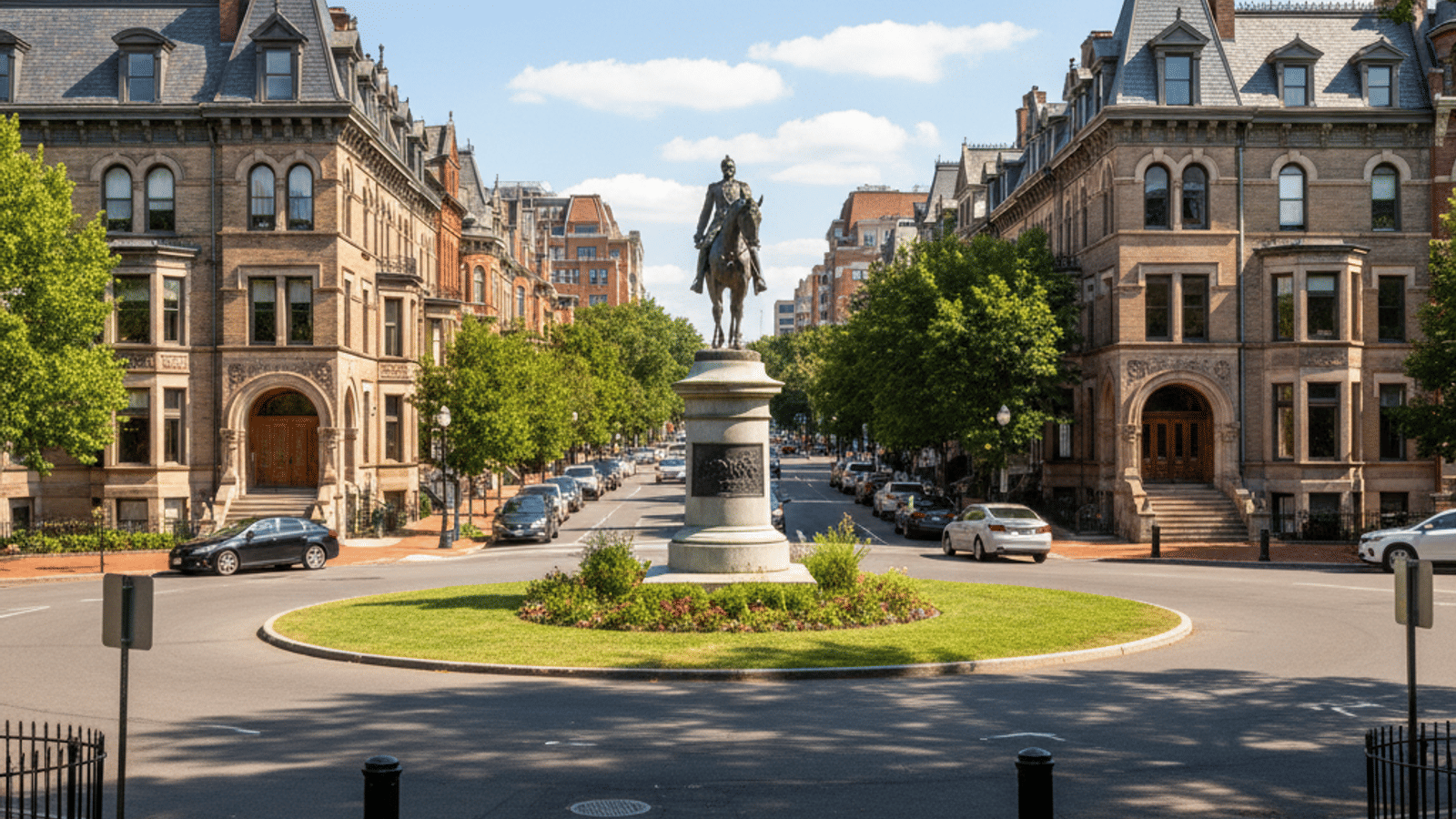
The crowning touch came at the turn of the century. In 1901, President William McKinley dedicated the bronze equestrian statue of General John A. Logan in the center of the park. It was a massive event that cemented the neighborhood’s prestige, even as the name “Iowa Circle” stuck around for another few decades.
Early 20th Century: Automobile Row and Demographic Shifts
As the 20th century progressed, the character of the neighborhood began to shift. The ultra-wealthy started moving further west toward Dupont Circle and Massachusetts Avenue, seeking larger plots of land. As the original families moved out, the commercial landscape moved in.
By the 1920s and 30s, the 14th Street corridor earned the nickname “Automobile Row.” The carriage houses and stables were replaced by car showrooms, repair shops, and garages. While the residential nature of the circle itself remained, the borders were becoming busier and more industrial.
During this time, the massive single-family mansions were often too expensive to maintain as private residences, so many were subdivided into rooming houses. The demographic shifted as well, and the neighborhood became a vibrant center for Black culture and intellect. Prominent figures like Mary McLeod Bethune lived and worked here, adding a rich layer of cultural history to the area’s narrative.
1968: The Riots and the Era of Decline
The most pivotal and painful moment in the neighborhood’s history occurred in 1968. Following the assassination of Dr. Martin Luther King Jr., Washington DC erupted in riots, and the 14th Street corridor was ground zero for much of the devastation.
Businesses were burned, and the economic heart of the area was shattered. For decades following the riots, Logan Circle suffered from severe disinvestment. Throughout the 1970s, 80s, and early 90s, the area struggled with high crime rates and developed a reputation as a “red light district.”
However, there is an ironic twist to this era of decline. Because there was no money flowing into the neighborhood, there was no money to tear anything down. In other parts of DC, historic homes were bulldozed to make way for concrete office blocks. In Logan Circle, the Victorian “bones” of the houses remained largely intact simply because redevelopment wasn’t financially viable. That neglect, painful as it was, inadvertently saved the architecture.
The Renaissance: Preservation and Revitalization
The climb back to prominence was slow and driven by the community. A major victory came on June 30, 1972, when the Logan Circle Historic District was added to the National Register of Historic Places. This designation provided the legal teeth needed to protect the facades of the remaining buildings from demolition.
The Logan Circle Community Association (LCCA) played a massive role during these years, fighting to preserve the neighborhood’s character even when property values were at rock bottom. Residents who bought in during the 80s and 90s spent years restoring these homes by hand, stripping paint and repairing woodwork.
If you ask locals about the turning point, most will point to the year 2000. That’s when Whole Foods opened on P Street. It sounds trivial, but that commercial anchor signaled to developers that the neighborhood was ready for large-scale investment. That sparked a wave of restoration that polished the rough edges and brought the circle itself back to its former glory under the care of the National Park Service.
Architectural Styles of Logan Circle
For architecture buffs, walking through Logan Circle is like taking a masterclass in 19th-century design. The variety here is stunning, and it’s a huge driver for people looking at rowhouses in DC.
The most prominent style you’ll see is the Second Empire, easily recognized by the slate Mansard roofs and dormer windows that allowed for a full third story of living space. You will also see plenty of Richardsonian Romanesque influence, characterized by heavy, rough-cut stone, deep arched entryways, and small turrets that give the homes a castle-like appearance.
Victorian Gothic elements are also scattered throughout, featuring intricate brickwork and steeply pitched gables. Keep an eye out for the “twin” apartment buildings, the Gladstone and the Hawarden, on R Street. Their majestic facades are some of the earliest examples of luxury apartment living in the city and remain architectural icons today.
Logan Circle Today: Living with History in 2026
So, what does all this history mean for you today? It means that when you are moving to Washington DC, Logan Circle offers a living experience that is distinct from the cookie-cutter condos in newer developments.
The neighborhood has fully arrived. In 2026, the contrast is what makes it special. You can have dinner at a trendy, Michelin-starred restaurant on 14th Street and then walk two blocks to sit on the steps of a mansion built in 1876. The circle itself acts as a communal “front yard” for residents, a place where the community gathers for picnics, dog walks, and casual conversation.
The property values here reflect this restored status. It is no longer an “up-and-coming” bet; it is a blue-chip asset. But beyond the numbers, you are buying into a neighborhood that has proven its resilience. It has survived war, riots, and neglect to emerge as one of the most beautiful and culturally rich pockets of the capital.