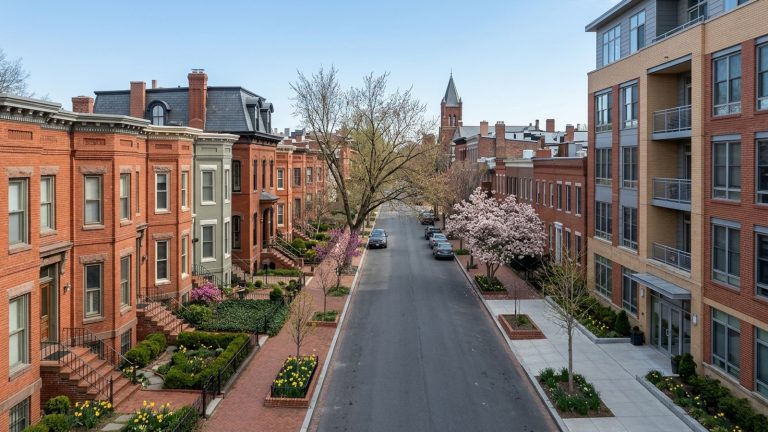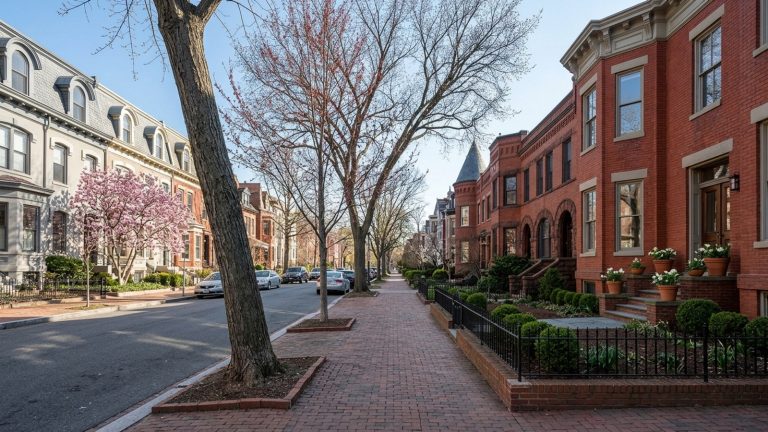

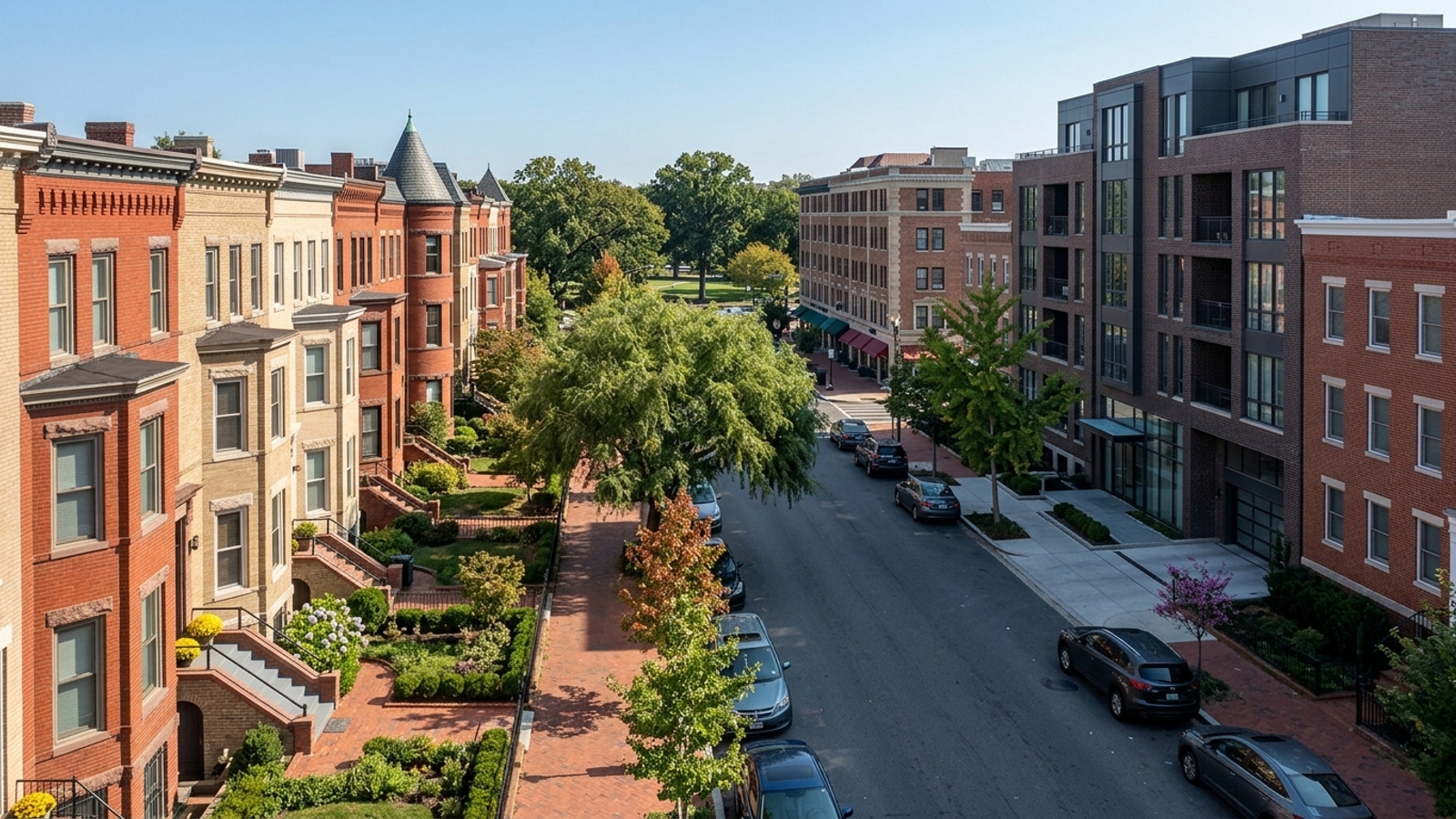
The median home sale price in Logan Circle recently hit $787,120, a figure that reflects the neighborhood’s position as one of Washington, DC’s higher-cost urban markets. At 0.22 square miles sitting dead center in the capital, it’s compact, walkable, and genuinely close to where a lot of people work.
Buyers and renters comparing notes on Washington, DC almost always put Logan Circle on the same list as Dupont Circle and Shaw. The decision usually comes down to three things: what you can spend, what kind of property you want, and how you get to work every day.
The Quick Verdict on Logan Circle
About 14,403 people live in those 0.22 square miles, which should give you a feel for how dense this place is. The housing stock splits between historic rowhouses and newer condo buildings, and the 14th Street corridor runs right through the western edge of it all.
If you work downtown, you can often get there on foot or on a bus without much drama. The tradeoff is that inventory is tight: homes are spending a median of 57 days on the market, and you’ll be competing for whatever comes up.
Pros of Living Here
Location is the obvious one. The 14th Street commercial corridor, restaurants, retail, all of it, is walkable from essentially anywhere in the neighborhood.
Transit is the other real advantage. You don’t need a car here. That’s not nothing when you’re running the numbers on monthly costs.
Cons to Consider
The financial barrier is real. Median sale prices are closing in on $800,000, and average rents regularly clear $2,500 a month. Neither of those figures leaves much room.
Space is the other thing people underestimate. At nearly 65,000 people per square mile, private yards and large floor plans aren’t part of the deal here.
Where Logan Circle Is Located
Logan Circle sits in Ward 2 of Washington, DC, under Advisory Neighborhood Commission 2F, ANC 2F, if you want the shorthand. That same commission covers Thomas Circle, Old City, Blagden Alley, Franklin Square, and portions of Shaw and Downtown. So when people say “Logan Circle,” they’re usually talking about a very specific 0.22-square-mile area anchored by a historic roundabout park of the same name.
Ward and ANC Boundaries
ANC 2F runs eight Single Member Districts, each with its own Commissioner. A portion of the broader area also reaches into ANC 2B, specifically SMD 2B05, which overlaps with Dupont Circle and Downtown.
These commissions aren’t just administrative paperwork. They handle local zoning, liquor licenses, and municipal feedback, so if you’re planning renovations or thinking about opening a business, ANC 2F is going to be part of that conversation.
Population and Density
The 2020 Census puts the population of the combined tracts that make up the neighborhood at 14,403, which works out to roughly 64,878 people per square mile. Other data models using slightly different tract definitions put the population somewhere between 10,000 and 15,784 depending on where you draw the line. Either way, this is one of the denser sections of the city.
Logan Circle Crime Statistics
Logan Circle falls under the Metropolitan Police Department’s Third District. Most of the neighborhood sits in Police Service Area 307, the largest PSA within ANC 2F, though portions extend into PSAs 301, 207, 208, and 209.
The trend line here is moving in the right direction. Between 2023 and 2024, violent crimes across the ANC 2F jurisdiction dropped 30%, going from 60 incidents to 42. Property crimes fell about 17% over the same period, from 729 down to 604. Car break-ins dropped from 184 to 132, and motor vehicle thefts fell from 70 to 48.
Current MPD Crime Rates
A 2024 police liaison for PSA 307 noted it was the only PSA in the entire Third District to see a year-over-year crime decrease in 2023. Reports running into 2026 show double-digit percentage drops continuing in both violent and property crime categories.
Worth keeping in mind: these figures cover the full PSA and ANC jurisdictions, which include surrounding commercial blocks, not just residential streets.
How to Research Local Data
Don’t rely on reputation. Pull the actual numbers. The MPD Crime Cards portal gives you block-by-block incident data, and the FBI’s UCR/NIBRS databases provide standardized figures for the broader Ward 2 area. Searching specifically by PSA 307 gets you the clearest picture of what’s happening on your actual street before you sign anything.
Housing Costs and Living Expenses
In late 2026, the median sale price sits at approximately $787,120, up 6.7% year-over-year. Properties are spending a median of 57 days on the market, there are about 117 active listings available, and supply sits at 4.1 months. Sellers are receiving an average of 98.3% of list price, and roughly 19.6% of homes are selling above asking.
That’s a competitive market, though not a frenzied one. Anyone buying a home in Logan Circle, Washington can browse active listings to see what fits their criteria.
Home Prices and Rent
The price range here is genuinely wide. Zillow places the average home value around $566,748 for condos and smaller units, but rowhouses in the Logan Circle Historic District frequently run well over $1.5 million. What you’re buying matters as much as where.
On the rental side, RentCafe reports average monthly costs between $2,504 and $2,536. Zumper puts the average a bit higher at $2,635 for the broader Logan Circle-Shaw area, and ApartmentHomeLiving currently lists its average at approximately $3,285 per month.
Income and Everyday Costs
The income picture is as varied as the housing. City-data reports a 2023 median household income of $122,500 for the neighborhood, compared to $108,210 for Washington, DC as a whole. Point2Homes cites a higher median of $138,730. A narrower census tract within the neighborhood, tract 91.02, shows a median of $71,215. Those numbers aren’t contradicting each other so much as reflecting how much economic range gets packed into a few square blocks.
Lifestyle, Climate, and Things to Do
The 14th Street corridor does most of the heavy lifting here. It runs through the western part of the neighborhood and is where you’ll find the bulk of the retail and dining. The rest is mostly residential: rowhouses, condo buildings, and the central roundabout park, which mapping sources note is one of about five parks and recreational areas in the immediate area.
14th Street Corridor and Dining
The corridor is where residents spend most of their time outside the house. Le Diplomate, the French restaurant, is probably the most recognizable name on the strip, alongside a range of cafes and local businesses.
Living close to 14th Street means foot traffic and noise come with the territory. Buyers who want something quieter tend to look at the residential cross-streets further east.
Parks and Green Spaces
The central Logan Circle park has historic statues, open seating, and doubles as a stop point for several bus routes. It’s genuinely pleasant. That said, the other small parks scattered through the area offer limited green space in what is, honestly, a concrete-heavy environment. If you want Rock Creek Park or real athletic fields, you’re traveling to get there.
Logan Circle vs. Nearby Neighborhoods
Logan Circle shares borders, and often the same buyer pool, with Dupont Circle to the west, Shaw to the east, and Downtown. They’re close enough that the comparison is inevitable.
Dupont Circle has a dedicated Metro station. Logan Circle doesn’t. Shaw has its own Metro access and a different mix of commercial development. Those two facts alone shape a lot of decisions.
Comparing Costs and Commutes
Dupont Circle tends to carry higher average price points and condo fees, even though the historic rowhouse stock looks similar. Shaw skews toward newer construction condos and sits in slightly different price tiers.
Getting around from Logan Circle means buses, bikes, and your own two feet. If your job requires the Metro’s Red Line, Dupont Circle is the more direct option. That’s just the geography.
Side-by-side comparisons: vs Philadelphia Pennsylvania, vs Columbia Heights, vs Capitol Hill, vs Adams Morgan, vs U Street Corridor. Related guides: Getting around Logan Circle, Washington, Cost of living in Logan Circle, Washington, Weather patterns in Logan Circle, Washington, Things to do in Logan Circle, Retirement communities in Logan Circle, Washington, Job market Logan Circle, Washington, Utilities in Logan Circle, Washington, History of Logan Circle, Washington, Is Logan Circle, Washington, DC safe, Schools in Logan Circle, Washington, Moving to Logan Circle, Hospitals in Logan Circle, Washington.
Frequently Asked Questions
Is Logan Circle, Washington, DC a Good Place to Live?
For people who want a central location and a walkable daily routine, yes. The 14th Street commercial corridor is right there, and downtown is close. The tradeoffs are a high cost of living and limited green space, both of which are real.
What Are the Cons of Living in Logan Circle?
Housing costs and the absence of a dedicated Metro rail station are the two biggest ones. The density, nearly 65,000 people per square mile, also means private outdoor space is essentially not available.
What Do the Crime Statistics Show for Logan Circle, Washington, DC?
MPD data shows falling crime rates. Between 2023 and 2024, violent crimes in the ANC 2F jurisdiction dropped 30%, and property crimes decreased by about 17%.
Is Logan Circle Expensive to Live In?
Yes. The median home sale price is around $787,120, and average rents range from $2,500 to over $3,200 per month depending on the source and unit size.
Is Logan Circle or Other DC Neighborhoods a Better Fit to Live In?
It depends on what you need. If Metro access is non-negotiable, Dupont Circle or Shaw may be the better fit. If walkability to the 14th Street dining corridor is the priority, Logan Circle makes more sense.
What Specialized Housing Options, Like Senior or Sober Living, Are Available in Logan Circle, Washington, DC?
Specific licensed facilities within the 0.22-square-mile boundary are limited. For senior, assisted, or sober living arrangements, the DC Department of Health and local housing authorities are the right places to look for options across the broader Ward 2 area.